
Table of Contents
Hey, Chris here -- it's amazing how fast AI financial modeling is changing.
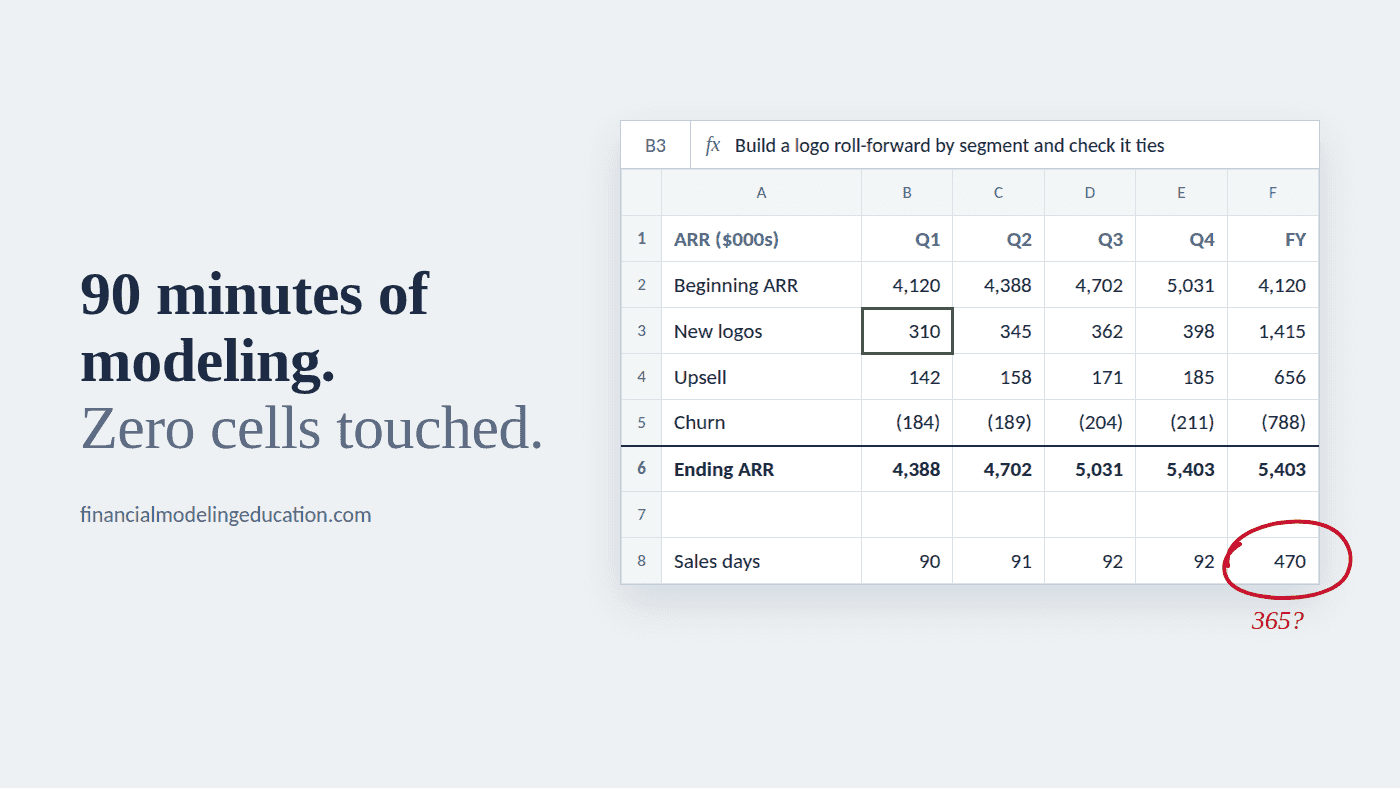
The other day I spent ~90 mins modeling and didn't touch the spreadsheet once.
It was purely done using AI.
What AI Financial Modeling Looked Like in Practice
I was working on an ARR roll-forward schedule and wanted better information on logos, upsell, and churn.
AI navigated a massive data source and correctly built a historical logo roll-forward and also updated my assumptions to better-reflect the historical churn and upsell by segment.
(I made sure to double-check all formulas and confirm everything ties).
Even more amazing, the client said, "no, I don't think we have a roll-forward for our [segment] business." But, AI was able to pull it together perfectly.
All of this still feels weird.
I'm now part-modeler, part-observer, part-auditor. It kind of feels like cheating?
I simultaneously love it and kind of hate it.
It also just makes me a little uneasy, but I suppose all new things do.
I'm still finding that although time spent is the same or possibly even more, the amount of productivity I'm getting out of that hour is unmatched.
When we're in-sync, I feel like I'm getting 3x my capacity with a really smart sidekick to help me.
Any questions I'm stuck on I can at least ask AI before I ask the client.
Even a shot in the dark: "Hey, can you look at the historical financials and help me build deferred revenue?"
Having this functionality is just so helpful.
And perhaps scariest: the double-checking / auditing / data review is now hard to comprehend without AI.
Gosh, what was I missing before?
Right now I'm really seeing the benefits: I'm building much better models for clients, and I assume the time spent will continue to drop.
I'm also using a blend of Claude and Copilot. Sort of comparing the two as I go.
This all comes with the caveat of I know what I'm doing.
Building by hand for ~20 years gives me the comfort to oversee AI financial modeling, to know what to ask for.
Where AI Still Gets It Wrong
Also, I am seeing it make mistakes as well.
It will miss context, misinterpret a formula, or make an assumption about the model that isn't true.
(It even told me there were sales 470 days in the year at one point 🤦♂️).
That's where the real experience comes in, and I'm thankful I have it in those moments.
5 Tips for AI Financial Modeling Right Now
Some tips for AI financial modeling that work really well right now:
- Work on one small section at a time. Don't ask it to build the whole model at once.
- Make your own call first, then compare it to AI's answer. You get two perspectives.
- Sanity-check outputs against things you know (days in a year, totals that should tie).
- Get confirmation before allowing edits.
- Make sure you truly understand the result well enough to explain it to someone else. (The humans still have the final say, for now).
All this sits within the broader context of AI's existential risk that's been in the news lately.
I'm not even really sure how to process all that.
When I see how helpful (and powerful) this technology is, it's hard to think these companies will pursue advancement at anything less than full speed.
But the "move fast and break things" approach in this industry carries risk we're seeing play out in real time.
It's fascinating and unnerving all at the same time.
I don't know. Time will tell.
Thanks as always for reading.
—Chris
Update: I've since written two follow-ups -- how I used AI to build a financial model executive summary, and how I used Claude to compare two financial models at once.
p.s., if there's one thing I've learned from all this, it's that subject matter expertise is more important than ever. Otherwise, you can end up in an "AI black hole" very quickly. I can help, click here to get dialed on the fundamentals.