
Table of Contents
Hey! Chris here, with a quick story about using AI to build a financial model executive summary.
Recently I wrote about how I spent 90 minutes modeling and didn't touch the spreadsheet once.
As I continue to do my song and dance with AI, going back-and-forth between human formulas and over-seeing the robot, I've found an area where AI really shines: making executive summaries.
How AI Built My Financial Model Executive Summary
First, I had it consolidate all three statements into an annual summary.
After a few iterations, I had it looking exactly how I wanted, with key items, and double-checks throughout.
Time (and client money) saved, maybe ~80%. Huge.
The Prompt I Used to Surface the KPIs
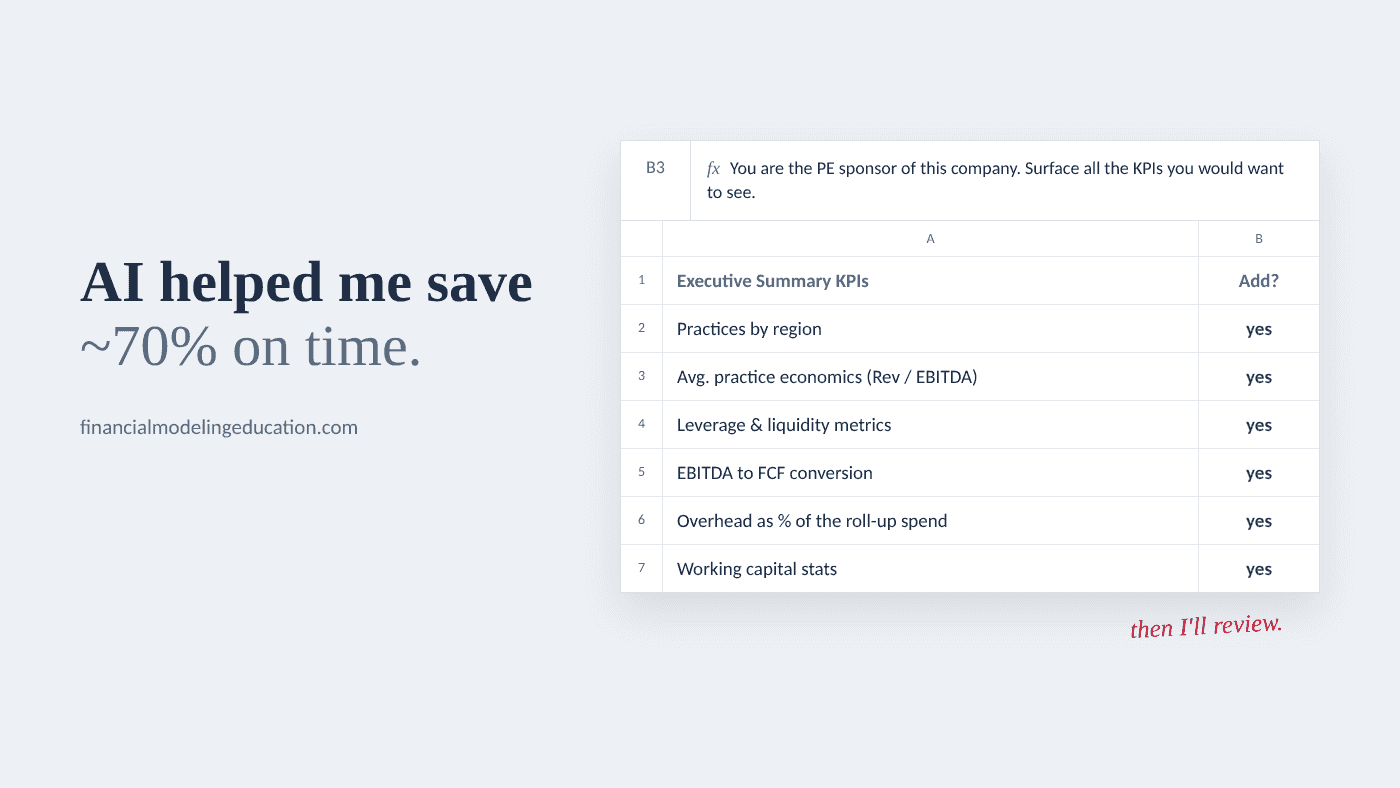
Then, I decided to push it a little, and gave it this prompt:
You are the PE sponsor of this company. Familiarize yourself with the entire model and surface all the KPIs you would want to see every time you receive the model.
The KPIs AI Came Up With
The model is a healthcare consolidation, and here's what it came up with:
- Practices by region
- Avg. Practice economics (Rev / EBITDA)
- Leverage & Liquidity metrics
- EBITDA to FCF conversion
- Overhead as % of the roll-up spend
- Working capital stats
- [A few other things that need to stay confidential]
My brain: "yes, yes, yes, and yes."
Please add all and then I'll review.
Once it was done, I cut a few items, asked to reshuffle some things, and build checks.
The result: a world class exec sum that took ~30% of the time, with a materially better output.
Reviewing the Model Like a Senior Person
A nice thing I'm noticing that was unexpected:
I'm reviewing the model like a senior person, and am less in the weeds.
Not caring so much about how AI created formulas to surface the number of practices, but rather, is the total number of practices correct?
(this is how your stakeholders look at things as well).
As we observe more and model less, I think there's a nice shift in thinking here to help focus on the big picture.
After all, the model has always been a tool to help us figure out what to do next. The model is not the business itself.
You Still Need to Know What You're Doing
Some things still ring true:
You need to know what you're doing.
All those metrics above? I easily confirmed them because I've looked at a million CIMs over the years and I'm familiar with what is being created.
6 Tips for Building a Financial Model Executive Summary With AI
My ongoing list of tips that work well right now:
- Work on one small section at a time. Don't ask it to build the whole model at once.
- You can be very specific and usually get a good result -- this thing is smart.
- Make your own call first, then compare it to AI's answer. You get two perspectives.
- You will probably learn some new stuff, but don't let your existing skills atrophy.
- Always build double-checks you can verify by hand.
- Make sure you truly understand the result well enough to explain it to someone else.
The Other Side of AI Modeling
As I type this email, I see a WSJ article about how Google's push of AI into schools is having a backlash (paywall), and suddenly I feel the other side of things.
I certainly feel myself being a bit lazier.
Am I really triggering "learning" in the traditional sense?
Am I slowly losing those skills as intelligence becomes cheaper?
What will this mean for my kids?
Tons of websites already contain some kind of chat feature. Will they even learn in a "traditional way," or is all that changing? And is it for the better?
Too early to say, but I'm watching closely.
Until next time.
—Chris
p.s., if there's one thing I've learned from all this AI modeling, it's that subject matter expertise is more important than ever. Otherwise, you can end up in an "AI black hole" very quickly. I can help, click here to master the fundamentals.
FAQs
Can AI build a financial model executive summary?
What prompt did you use to get the KPIs?
You are the PE sponsor of this company. Familiarize yourself with the entire model and surface all the KPIs you would want to see every time you receive the model.
What KPIs did AI suggest for the executive summary?
The model is a healthcare consolidation, and AI suggested practices by region, average practice economics (revenue and EBITDA), leverage and liquidity metrics, EBITDA to FCF conversion, overhead as a % of the roll-up spend, and working capital stats.
Do you still need modeling experience if AI builds the summary?
Yes. I could confirm the metrics quickly because I've looked at a lot of CIMs and I'm familiar with what was being created. Without that, it's hard to know whether the output is right.
How do you check AI's work in a financial model?
Build double-checks you can verify by hand, make your own call first and compare it to AI's answer, and make sure you understand the result well enough to explain it to someone else.